
In this issue
▾
There are places where I feel the need to speak.
And there are places where I don't.
The ocean has always belonged to the second category.
Whenever I find myself standing near the water, something inside me seems to become quieter. I don't need to solve anything. I don't need to make sense of the day. I can simply stand there and listen.
The waves arrive. They retreat. Then they return.
There is something deeply comforting about that rhythm.
I recently spent an afternoon by the sea with no particular plan. No camera in my hand, no list of places to visit, no deadline waiting for me. Just a quiet stretch of shoreline, warm sand beneath my feet, and the steady sound of water moving toward the coast.
I think I needed that more than I realized.
The first few minutes
At first, my mind was still busy.
I was thinking about messages I hadn't answered, things I needed to finish, ideas I wanted to write down. Even with the ocean in front of me, my thoughts were somewhere else.
Then I started walking. Slowly.
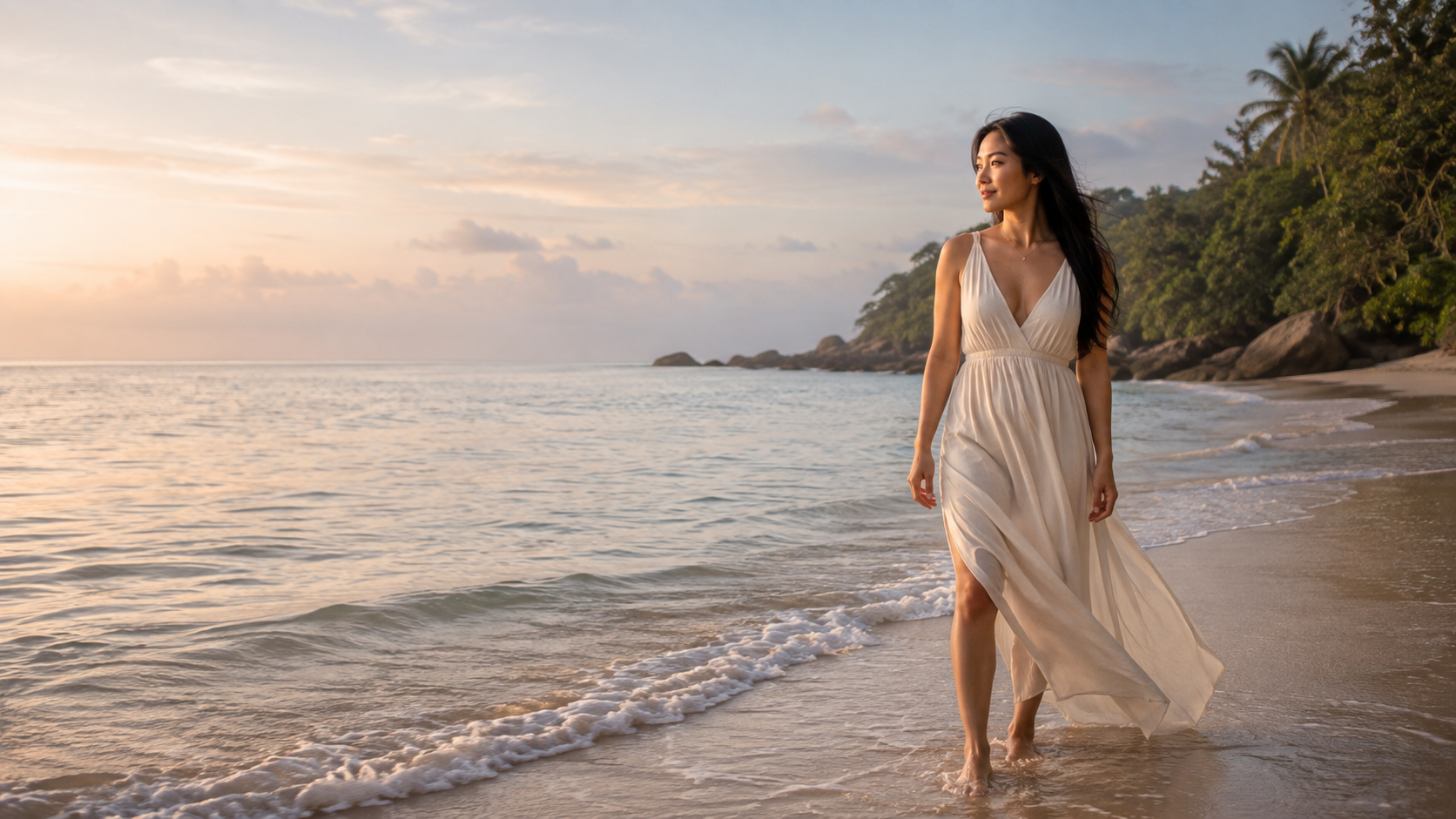
I left my shoes behind and let my feet meet the wet sand where the waves had just disappeared. The water was cool against my ankles. A breeze moved through my hair. Somewhere nearby, someone was laughing.
Little by little, my attention returned to where I actually was.
That's when I noticed something simple. The ocean doesn't ask you to hurry. It doesn't reward speed. It doesn't care how much you've accomplished today.
It simply moves. And perhaps that's why being near water can feel so restorative.
A different kind of quiet
We often think of silence as the absence of sound. The ocean taught me otherwise.
The sea is never truly silent. There is the movement of waves, the wind, distant voices, seabirds, footsteps in the sand. Yet somehow, all those sounds create a kind of quiet.
A quiet inside the mind.
“I've started thinking of this as soft attention — the kind of attention that doesn't demand anything from you.”
You aren't trying to concentrate. You aren't trying to meditate perfectly. You're simply noticing.
- The changing color of the water.
- The shape of clouds.
- The warmth of sunlight on your shoulders.
- The foam disappearing between your toes.
For a few minutes, that's enough.
Why I keep returning
I don't believe the ocean magically fixes difficult days. Life doesn't work that way.
A beautiful view cannot erase a difficult conversation or solve a problem waiting at home. But nature can give us something incredibly valuable: perspective.
Standing beside something as vast as the sea makes my own thoughts feel a little less enormous. The problem is still there. But it no longer fills the entire horizon.
That's what I mean when I call the ocean a form of therapy—not as a replacement for professional mental health care, but as a personal ritual that helps me pause, breathe, and reconnect with myself.
Sometimes wellness isn't about adding another task to your routine. Sometimes it's about stepping outside it.
My simple ocean ritual
Whenever I have the opportunity, I like to keep my time by the water uncomplicated.
- I arrive without a strict schedule.
- I walk for a while.
- I leave my phone in my bag.
- I find a quiet place to sit.
- Then I watch the waves.
Sometimes I write a few thoughts in my journal. Sometimes I don't write anything at all.
Before leaving, I take five slow breaths and ask myself one question: What can I leave here?
It might be an anxious thought. A deadline I've been carrying too heavily. The need to have everything figured out. Or simply the expectation that every day needs to be productive.
I don't always have an answer. I don't think I need one.
Let the tide remind you
The ocean has never been afraid of returning. Every wave disappears, only to become part of another wave.
There is something beautiful in that.
We have our own cycles too. Some days are energetic and full. Others feel slow and uncertain. Some mornings we know exactly where we're going. Other days we simply need to keep moving gently forward.
None of that means we're falling behind. Perhaps we're just between waves.
And if you don't live near the coast, find your own version of that feeling—a quiet park, a forest path, a lake, a garden, or even an open window on a rainy afternoon.
The goal isn't necessarily the ocean. It's the pause. The reminder that you are allowed to stop, breathe, and simply be where you are.
Because sometimes healing doesn't arrive as a grand revelation. Sometimes it sounds like waves reaching the shore, again and again, patiently reminding us that everything moves.
Including us.
— Mila Tan